


- VSR (video super-resolution) + closed-set classifier track post-processing: refine classes and filter false positives after ByteTrack (demo pipeline,
-DUSE_VSR=ON, see the section below) - Add geographiclib for vehicles speed estimation geographiclib/geographiclib
- Add YOLOE detection support THU-MIG/yoloe
- Add new SOTA: YOLOv26, YOLOv26-obb and YOLOv26-seg models from ultralytics/ultralytics
- Add RT-DETRv4 (API similar D-FINE) detection model RT-DETRs/RT-DETRv4
- Add D-FINE seg detection model ArgoHA/D-FINE-seg
- Add ByteTrack MOT algorithm based on Vertical-Beach/ByteTrack-cpp
- Big code cleanup from old style algorithms and detectors: some bgfg detectors, some VOT trackes, Face and Pedestrin detectors, Darknet based backend for old YOLO etc
- YOLOv13 detector works with TensorRT! Export pre-trained PyTorch models here (iMoonLab/yolov13) to ONNX format and run Multitarget-tracker with
-e=3example - Instance segmentation model from RF-DETR detector works with TensorRT! Export pre-trained PyTorch models here (roboflow/rf-detr) to ONNX format and run Multitarget-tracker with
-e=3example - New linear assignment algorithm - Jonker-Volgenant / LAPJV algorithm used in scipy as alternative for Hungarian allgorithm
- D-FINE detector works with TensorRT! Export pre-trained PyTorch models here (Peterande/D-FINE) to ONNX format and run Multitarget-tracker with
-e=3example - RF-DETR detector works with TensorRT! Export pre-trained PyTorch models here (roboflow/rf-detr) to ONNX format and run Multitarget-tracker with
-e=3example - YOLOv12 detector works with TensorRT! Export pre-trained PyTorch models here (sunsmarterjie/yolov12) to ONNX format and run Multitarget-tracker with
-e=3example
A/B on MOT20 train (4 sequences, 8931 frames) and VisDrone-MOT2019 val (7 sequences, 2846 frames). Both runs use the same TensorRT detector and the same UniversalTracker; only ReID settings differ. ByteTrack does not use ReID, so it is not part of this A/B. MOT20 uses the person OSNet model; VisDrone uses person OSNet + vehicle ResNet50.
Metrics are from mot_eval (CLEAR MOT + ID measures); timing includes frame
reading, detection, tracking, ReID and result writing. Hardware: RTX 4070
Laptop, TensorRT 10.16, OpenCV 4.14 CUDA FP16.
| Dataset | ReID config | MOTA | IDF1 | IDSW | FP | FN | Recall | ms/frame |
|---|---|---|---|---|---|---|---|---|
| MOT20 | off (IoU only) | 0.181 | 0.266 | 4786 | 110005 | 814420 | 0.282 | 33.6 |
| MOT20 | 0.5 IoU / 0.5 ReID, gallery 15 | 0.111 | 0.136 | 10329 | 50597 | 947346 | 0.165 | 78.4 |
| MOT20 | 0.8 IoU / 0.2 ReID, gallery 5 | 0.188 | 0.274 | 4493 | 96435 | 820714 | 0.277 | 76.4 |
| VisDrone | off (IoU only) | -1.913 | 0.196 | 4758 | 288279 | 39376 | 0.655 | 57.8 |
| VisDrone | 0.5 IoU / 0.5 ReID, gallery 15 | -0.583 | 0.300 | 2432 | 130698 | 47545 | 0.583 | 427.6 |
How to read it. On MOT20 the aggressive 0.5/0.5 ReID setting is
harmful: it cuts FP but also cuts recall and more than doubles IDSW. Lowering
the ReID weight to 0.2 and reducing the gallery to 5 (min_quality=0.5)
recovers a small gain over IoU-only. On VisDrone ReID reduces FP/IDSW and
improves MOTA/IDF1, but recall drops and the run is about 7x slower. VisDrone
MOTA is negative because the detector finds many objects that are not annotated
in the GT; compare IDF1/IDSW/FP/FN rather than MOTA alone.
ReID is disabled by default. The detailed settings, model preprocessing and interpretation are in docs/reid.md.
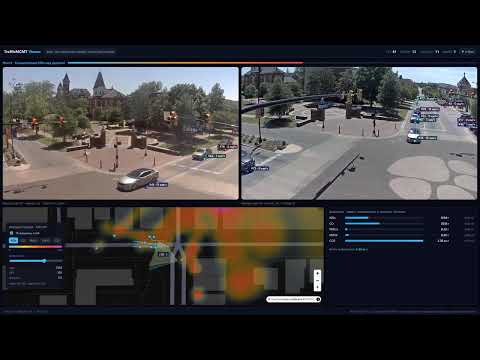
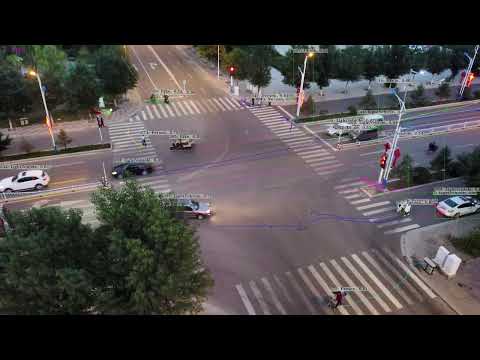
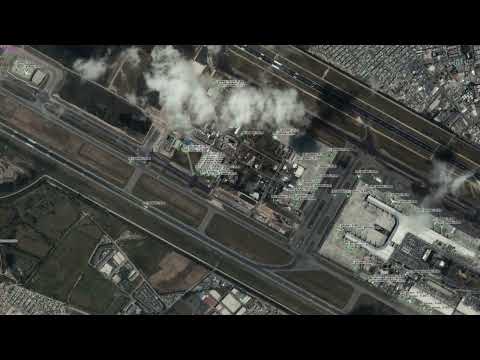
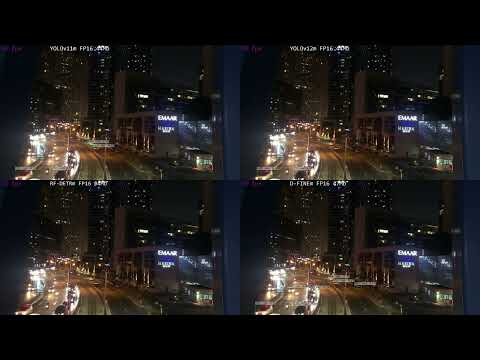
Available through CreateDetector function with different detectorType:
- Background Subtraction:
- Built-in: VIBE (
tracking::Motion_VIBE), SuBSENSE (tracking::Motion_SuBSENSE), LOBSTER (tracking::Motion_LOBSTER) - OpenCV: MOG2 (
tracking::Motion_MOG2) - OpenCV Contrib: MOG (
tracking::Motion_MOG), GMG (tracking::Motion_GMG), CNT (tracking::Motion_CNT) - Foreground segmentation uses OpenCV contours producing
cv::RotatedRect
- Built-in: VIBE (
- Deep Learning Models:
- OpenCV DNN module (
tracking::DNN_OCV) - TensorRT-accelerated YOLO (
tracking::Yolo_TensorRT)
- OpenCV DNN module (
For solving assignment problems:
- Hungarian Algorithm (
tracking::MatchHungrian) - O(N³) complexity - LAPJV (
tracking::MatchLAPJV) - O(M*N²) complexity - Distance Metrics:
- Center distance (
tracking::DistCenters) - Bounding box distance (
tracking::DistRects) - Jaccard/IoU similarity (
tracking::DistJaccard)
- Center distance (
- Kalman filters: Linear (
tracking::KalmanLinear), Unscented (tracking::KalmanUnscented) and augmented Unscented (tracking::KalmanAugmentedUnscented) - State models: Constant velocity and constant acceleration (for all tracking modes)
- Tracking modes: Position-only (
tracking::FilterCenter), position+size (tracking::FilterRect) and rotated rectangle (tracking::FilterRRect) - Velocity:
TrackingObject::m_velocityis the displacement per filter step (delta_time), not pixels/sec;m_speedMpsis the metric speed in m/s (when local coordinates are available) - Specialized features: Abandoned object detection, line intersection counting
When targets disappear:
- KCF (
tracking::TrackKCF) - CSRT (
tracking::TrackCSRT) - DaSiamRPN (
tracking::TrackDaSiamRPN) - Vit (
tracking::TrackVit) - Nano (
tracking::TrackNano)
- Synchronous (
SyncProcess): Single-threaded processing - Asynchronous (2 threads) (
AsyncProcess): Decouples detection and tracking - Fully Asynchronous (4 threads): For low-FPS deep learning detectors
git clone https://github.com/Smorodov/Multitarget-tracker.git
cd Multitarget-tracker
mkdir build && cd build
cmake . .. \
  -DUSE_OCV_BGFG=ON \
  -DUSE_OCV_KCF=ON \
  -DUSE_OCV_UKF=ON \
  -DBUILD_ONNX_TENSORRT=ON \
  -DBUILD_ASYNC_DETECTOR=ON \
  -DBUILD_CARS_COUNTING=ON
make -jRuCLIP is not built here — it is a standalone CMake package (ruclip::ruclip)
that supports LibTorch, TensorRT and OpenCV DNN backends. Build and install it once,
then point CMake at the installed package:
# in the RuCLIP checkout (TensorRT backend; see its README for the precise paths)
cmake -S RuCLIP -B build -DRUCLIP_WITH_TORCH=OFF -DRUCLIP_WITH_TRT=ON \
      -DRUCLIP_BUILD_CLI=OFF -DCMAKE_INSTALL_PREFIX=<prefix>
cmake --build build --config Release && cmake --install build --config Release

# in Multitarget-tracker
cmake . .. -DUSE_CLIP=ON -DruCLIP_DIR=<prefix>/lib/cmake/ruCLIP
The motion example (-e=1) uses the TensorRT backend with FP16 (--fp16 engine,
clip_*.fp16.gpu<N>.b<B>.engine), so the model directory must contain the exported
ONNX files (clip_visual.onnx, clip_textual.onnx). At runtime the app needs the
TensorRT/CUDA/cuDNN and OpenCV DLL directories on PATH.
Classification parameters live in the [clip] section of the settings ini file
(see data/settings_motion_clip.ini): model
directory, prompts, backend, FP16, a catch-all reject_label, a confidence
threshold and the per-track recheck_interval. Pass it with
--settings=../data/settings_motion_clip.ini; without model_dir/labels the
classification stays disabled even when built with USE_CLIP=ON.
A demo post-processor that runs after ByteTrack and re-scores each track with
a closed-set classifier (yolo11s-cls) on the detector crop — either the raw
crop (variant=0) or the crop restored by a K-frame video-super-resolution (VSR)
engine (variant=1) — then drops tracks whose max-softmax confidence is below an
OOD threshold. It can refine classes and remove false positives from the output;
the tracker itself is left untouched.
Build with -DUSE_VSR=ON. It links the external vsr_inference package
(vsr::vsr_inference) and needs TensorRT/CUDA:
cmake . .. -DUSE_VSR=ON \
  -DVSR_INFERENCE_DIR=<vsr_inference install prefix> \
  -DTRT_INCLUDE_DIR=<TensorRT include dir> -DCUDA_INCLUDE_DIR=<CUDA include dir>
Settings live in the [postprocess] section of the ini file (see
data/settings_visdrone_yolo11s.ini):
variant, cls_engine/cls_names/cls_size, vsr_engine/vsr_k/vsr_lr_size/
vsr_target_frame, msp_threshold, recheck_interval, min_object_side, dump.
enable = 0 keeps the plain detector + ByteTrack baseline.
Note: the vsr_inference header documents the crop layout as HWC, but the
TensorRT graph is exported as [1,K,3,H,W] -> [1,K,3,4H,4W] (planar CHW per
frame); TrackPostProcessor packs/reads CHW accordingly.
Basic command syntax:
./MultitargetTracker <video_path> [--example=<num>] [--start_frame=<num>]
                     [--end_frame=<num>] [--end_delay=<ms>] [--out=<filename>]
                     [--show_logs] [--gpu] [--async] [--res=<filename>]
                     [--settings=<filename>] [--batch_size=<num>]
Example:
./MultitargetTracker ../data/atrium.avi -e=1 -o=../data/atrium_motion.aviKeyboard Controls:
m: Toggle play/pause- Any key: Step forward when paused
Esc: Exit
#include <mtracking/BaseTracker.h>

std::unique_ptr<BaseTracker> m_tracker;
TrackerSettings settings;
settings.SetDistance(tracking::DistJaccard);
m_tracker = BaseTracker::CreateTracker(settings);- OpenCV (and contrib)
- Vibe
- Non Maximum Suppression
- Ini file parser
- Circular Code
- RuCLIP (optional, standalone package; TensorRT backend) — object classification in the motion example
- Jeroen PROVOOST "Camera gebaseerde analysevan de verkeersstromen aaneen kruispunt", 2014 ( https://iiw.kuleuven.be/onderzoek/eavise/mastertheses/provoost.pdf )
- Roberto Ciano, Dimitrij Klesev "Autonome Roboterschwarme in geschlossenen Raumen", 2015 ( https://www.hs-furtwangen.de/fileadmin/user_upload/fak_IN/Dokumente/Forschung_InformatikJournal/informatikJournal_2016.pdf#page=18 )
- Wenda Qin, Tian Zhang, Junhe Chen "Traffic Monitoring By Video: Vehicles Tracking and Vehicle Data Analysing", 2016 ( http://cs-people.bu.edu/wdqin/FinalProject/CS585%20FinalProjectReport.html )
- Ipek BARIS "CLASSIFICATION AND TRACKING OF VEHICLES WITH HYBRID CAMERA SYSTEMS", 2016 ( http://cvrg.iyte.edu.tr/publications/IpekBaris_MScThesis.pdf )
- Cheng-Ta Lee, Albert Y. Chen, Cheng-Yi Chang "In-building Coverage of Automated External Defibrillators Considering Pedestrian Flow", 2016 ( http://www.see.eng.osaka-u.ac.jp/seeit/icccbe2016/Proceedings/Full_Papers/092-132.pdf )
- Roberto Ciano, Dimitrij Klesev "Autonome Roboterschwarme in geschlossenen Raumen" in "informatikJournal 2016/17", 2017 ( https://docplayer.org/124538994-2016-17-informatikjournal-2016-17-aktuelle-berichte-aus-forschung-und-lehre-der-fakultaet-informatik.html )
- Omid Noorshams "Automated systems to assess weights and activity in grouphoused mice", 2017 ( https://pdfs.semanticscholar.org/e5ff/f04b4200c149fb39d56f171ba7056ab798d3.pdf )
- RADEK VOPÁLENSKÝ "DETECTION,TRACKING AND CLASSIFICATION OF VEHICLES", 2018 ( https://www.vutbr.cz/www_base/zav_prace_soubor_verejne.php?file_id=181063 )
- Márk Rátosi, Gyula Simon "Real-Time Localization and Tracking using Visible Light Communication", 2018 ( https://ieeexplore.ieee.org/abstract/document/8533800 )
- Thi Nha Ngo, Kung-Chin Wu, En-Cheng Yang, Ta-Te Lin "A real-time imaging system for multiple honey bee tracking and activity monitoring", 2019 ( https://www.sciencedirect.com/science/article/pii/S0168169919301498 )
- Tiago Miguel, Rodrigues de Almeida "Multi-Camera and Multi-Algorithm Architecture for VisualPerception onboard the ATLASCAR2", 2019 ( http://lars.mec.ua.pt/public/LAR%20Projects/Vision/2019_TiagoAlmeida/Thesis_Tiago_AlmeidaVF_26Jul2019.pdf )
- ROS, http://docs.ros.org/lunar/api/costmap_converter/html/Ctracker_8cpp_source.html
- Sangeeth Kochanthara, Yanja Dajsuren, Loek Cleophas, Mark van den Brand "Painting the Landscape of Automotive Software in GitHub", 2022 ( https://arxiv.org/abs/2203.08936 )
- Fesus, A., Kovari, B., Becsi, T., Leginusz, L. "Dynamic Prompt-Based Approach for Open Vocabulary Multi-Object Tracking", 2025 ( https://link.springer.com/chapter/10.1007/978-3-031-81799-1_25 )